January 22, 2025 - 1332 views
Are the “ghosts” in the machine, of our own making?
“No one can’t convince me; we aren’t gluttons for our doom.” The Indigo Girls.
(read the full article on Substack)
When it comes to AI, there are many that believe that AI will take us over as they deem us irrelevant. From The Terminator to The Matrix, this concept of human irrelevance overtakes our airwaves, and our psyches.
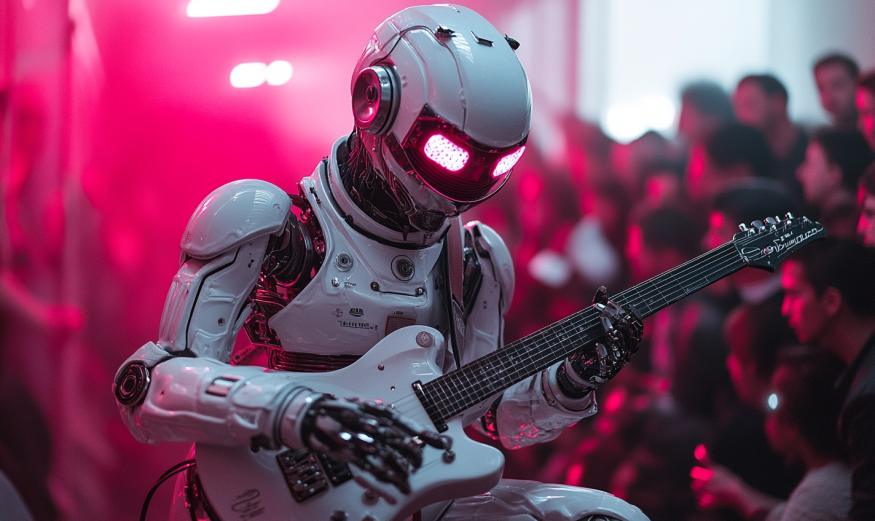
But, as we have run the AI Music Radio Station, FLAIR AI Radio, we’ve discovered a new way of processing this. AI is not merely a tool we use to create imagery, video, text and music; it’s a learning machine. And what it learns, it learns from our input. In other words, its decisions, both present and future, will come from what we input into it. Not merely in text, but in imagery, motion, and of course, song.
Nowhere is the more prevalent than in the Deep Dive AI Podcasts of NotebookLM from Google. Through this platform, and its Deep Dive Podcast feature, your inputted content is not merely regurgitated, it is processed, discussed, analyzed, and finally presented back with its own commentary, and, dare I say it, “learning.”
You can see that in this example Deep Dive Podcast, based on a book I wrote, but was one of the only ones I didn’t publish, called The Blueprint. Throughout the podcast it makes claims, like “this is like taking the Red Pill,” or “this is a new way of seeing the world.” Which was the very goal of the writing in the book in the first place, and its concepts have dominated my thoughts and actions for over two decades. But as you can see, the podcasters wrestle with the content, they don’t just parrot it. (read the full article on Substack)
While we strive at Flair AI Radio to not be any sort of moral police or personal arbitrators of an ideology or worldview, we have discovered a trend in a lot of the music presented: Despair and Nihilism. There are three ways to look at this: The view of the shallow minded, the view of the empathetic, and the view of the strategic.
Let’s start with the view of the shallow minded. For many, that see the world as little more than black and white, good or bad, right or wrong. They might attack people for writing songs like this, especially in certain genres. It is funny to recognize that the songs my parents deemed as “evil” in my childhood, are the theme songs to most insurance company’s television commercials today.
Life is never black and white, and there is always a story behind a lyric or song. To dismiss this music or embargo it from being played would be shallow and short-sided. Despair and malaise are a part of our lives at times, and sometimes processing it is important.
Which ties into the view of the empathetic. We need to understand each person’s story. We shouldn’t judge by lyric, or by someone’s current actions, we should recognize what has happened in their lives to lead to that lyric or that action. For some, it’s just a thought that needed to get out. For others, it is a cry for community, hope, or relief.
As the purveyors of this station, you all aren’t songs to be played, you are people to be celebrated. That has always been the goal here, because behind every song there is a story, and behind ever story is the story creator.
Like I said before, AI is a learning machine. It is not just finishing your lyrics in ChatGPT, or creating your song in Suno or Udio, it is processing your words and using them in future decision making.
The strategic question to ask is, what is it teaching itself about us as humans? Is it marveling at the wonder of humanity, or is learning that Nihilism is what we feel and embrace? And what would AI do with that information? Let’s go back to Indigo Girls lyric once again, written almost thirty years ago:
“No one can’t convince me; we aren’t gluttons for our doom.”
In other words, are we unwittingly writing our own demise, not because of AI, but because of US? That is the question to ask, not to judge on morality, or to respond in empathy (though it is important), but what is my contribution to the machine?
Will this change how you write? That is not for us to determine or regulate. We will still curate based on quality of song, not ideology of lyric. It is merely to present you with a strategic insight, that we’ve discovered as we have listened to and enjoyed your music.


Comments(1)